Using Anima – a simple way to contact the surgery
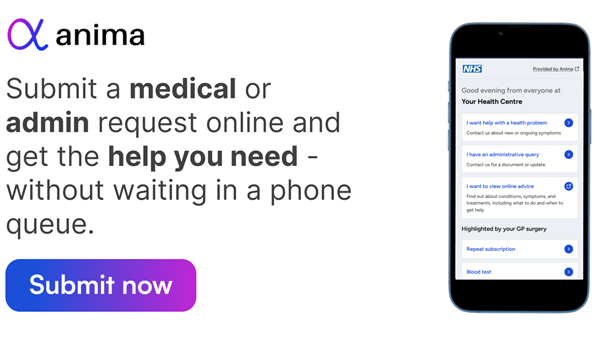
Anima is our online system for contacting the surgery. It gives you a quick and convenient way to tell us what you need without having to wait on the telephone or visit the practice.
You can use Anima for health problems, medication requests and many other queries.
The information you provide helps us understand what you need and direct your request to the right person in the practice team.
Why use Anima?
Anima allows you to:
- Contact the surgery online at a convenient time.
- Avoid waiting in a telephone queue.
- Tell us about your problem in your own words.
- Provide useful information before your request is reviewed.
- Send medication and prescription requests.
- Receive messages and updates from the surgery.
- Help us direct your request to the most appropriate member of the team.
You don't need to know who you need to see or which type of appointment to book – tell us what you need help with and we can work out the most appropriate next step.
What can I use Anima for?
You can use Anima for many of the things you would previously have contacted reception about, including:
- A new health problem
- An ongoing health problem
- Repeat prescriptions
- One-off medication requests
- Questions about your medication
- Fit note requests
- Questions about results
- Administrative queries
- Other requests for help from the practice
Simply write briefly your concern or request and Anima will guide you through the relevant questions. E.g. ‘sore throat’, ‘follow up appointment’, ‘recent test results’
💊 Requesting medication through Anima
Anima can be used for repeat prescriptions, one-off medication requests and medication queries.
The easiest way to submit a medication request is:
1. Choose the top option – “I want help with a health problem”.
2. Start typing what you need, for example:
· Repeat prescription
· One-off medication
· Medication query
Anima will then guide you through a few questions so that we have the information needed to deal with your request.
Ordering several repeat medications?
If you take several regular medications, you don't need to type the name of every item individually.
If you need everything on your repeat medication list, simply write:
“All repeats”
If you need most of your medication but not everything, you can write:
“All repeats except…”
and tell us which medication you don't need.
For example:
“All repeats except my inhaler.”
If you only need one or two particular medications, please give us the medication names where possible.
“I just want an appointment – why do I have to answer questions?”
We understand that sometimes you simply want to know whether you can see or speak to someone.
The questions in Anima help us understand what you need before deciding the most appropriate way to help you.
Not every request needs the same type of appointment or the same member of the practice team. Depending on your request, the next step could be an appointment, advice from a clinician, a prescription, a referral or help from another service.
Providing some information at the beginning helps us make sure you receive the right care from the right person.
What should I tell you?
You don't need to use medical terminology or know what might be causing your symptoms.
Just tell us, in your own words:
- What is happening?
- How long has it been happening?
- Is it getting better or worse?
- Is there anything in particular you are worried about?
- What would you like us to help you with?
The more relevant information you can provide, the easier it is for our team to understand your request.
What happens after I submit my request?
Your request is sent securely to the practice for review.
We will look at the information you have provided and decide the most appropriate next step. This doesn't always mean a GP appointment – another member of the practice team or another service may sometimes be better placed to help you.
We will then contact you to let you know what happens next.
Please keep an eye on your messages after submitting an Anima request, as we may need to ask you for further information or send you advice.
It is also important that the contact details we hold for you are up to date.
Can I send photographs or documents?
Where appropriate, Anima allows you to provide additional information with your request.
A photograph or document can sometimes help us understand what you need and may prevent us having to contact you again for further information.
Please only send photographs or documents that are relevant to your request.
Anima is continuing to improve
Anima is regularly updated and developed to make it easier for patients and practices to use.
The system continues to evolve based on how it is being used and feedback from patients and GP practices, with improvements and new features introduced over time.
This means you may occasionally notice changes to the questions you are asked or the way Anima looks and works.
Can I still speak to reception?
Yes 😊
Anima provides a convenient way to contact us online, but we understand that not everybody can use an online service independently.
If you are unable to use Anima or need help submitting a request, please contact our reception team. We will help you access the service in the most appropriate way.
Please remember that our receptionists may need to ask you some questions about your request. This is so that we can make sure you receive the appropriate help – you are not expected to decide which clinician or appointment you need yourself.
Having problems using Anima?
Please don't worry if you're not confident using online services.
If you are having difficulty accessing Anima, completing the questions or submitting your request, please speak to our reception team.
We would much rather help you use the service than have you go without the care or support you need.
🚨 If you need urgent help
Anima should never delay you from seeking emergency medical help.
If you believe you or somebody else is experiencing a life-threatening medical emergency, call 999.
For urgent medical advice when the surgery is closed, please use the appropriate NHS urgent care service.
Making it easier to contact your surgery
Moving more requests online isn't about creating a barrier between patients and the practice.
Anima helps us gather the information we need at the beginning, manage requests safely and direct patients to the most appropriate person or service.
For many patients, it also means being able to contact the surgery without waiting on the telephone.
And if you need some help using it, our reception team is here to support you.